

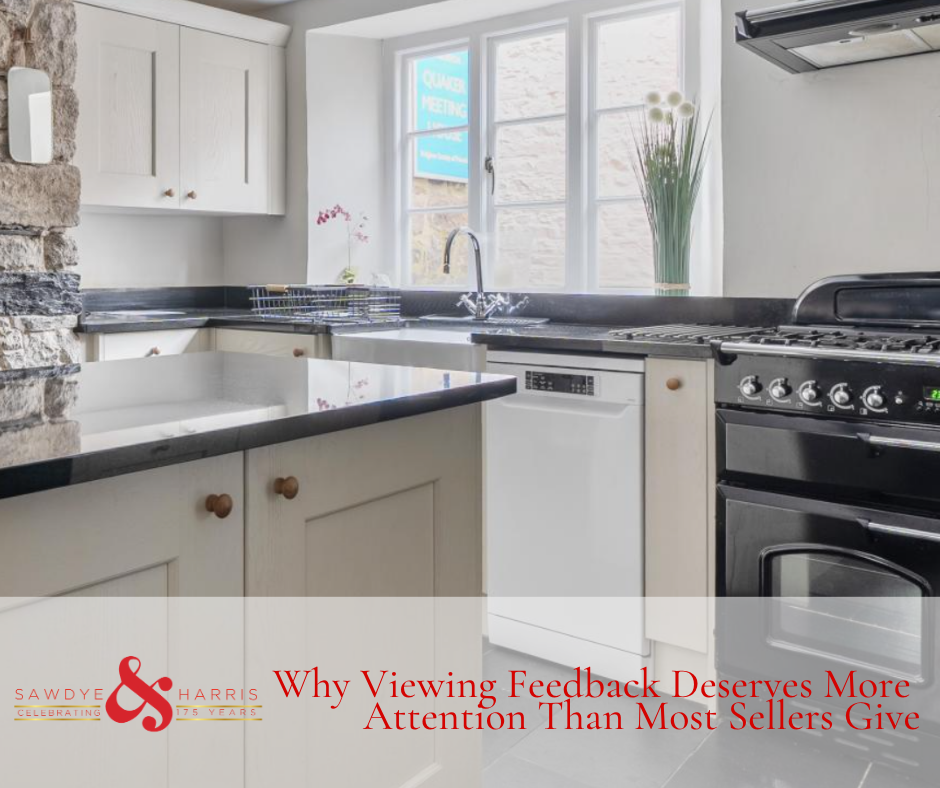
Why Viewing Feedback Deserves More Attention Than Most Sellers Give It
Cosmo Sales Blog - September 2026
After every viewing, we ask for feedback and pass it straight on. Most sellers read it, form a quick opinion about whether it was fair, and move on. That's understandable. Nobody enjoys hearing that a stranger wasn't won over by their home. But feedback isn't really about one person's taste. Looked at properly, over several viewings, it tells you something far more useful: what's actually standing between your home and an offer.
One comment is opinion. A pattern is information.
If one buyer says the kitchen feels dated, that's one person's view and it might mean nothing at all. If four buyers say it independently, across different weeks, with no connection to each other, that's not a coincidence. That's a pattern, and patterns are worth acting on.
The trouble is, sellers tend to respond to the first version rather than the second. A single piece of blunt feedback gets dismissed as fussy or unfair, and by the time three more viewings have said something similar, it's been mentally filed under "buyers being picky" rather than treated as a signal. Six weeks later, the same objection is still coming up, nothing has changed, and the seller is left wondering why the phone has gone quiet.
Part of the problem is that feedback tends to arrive in small doses, spaced out over weeks, so the pattern is genuinely hard to spot from the inside. Sellers remember the last viewing, maybe the one before it, but rarely hold all six or seven comments in their head at once and compare them side by side. An agent who's collecting and reviewing every piece of feedback is in a much better position to see the shape of what's actually happening, simply because they're looking at the whole picture rather than one viewing at a time.
Why the feedback that stings the most is usually the most useful
There's a natural instinct to brush off comments that feel personal, particularly about a home you've lived in and cared for. But the feedback that's hardest to hear is very often the feedback that matters most, because it's pointing at something specific rather than something vague. "Lovely house, just not for us" tells you very little. "We loved the garden but couldn't see past the artexceilings" tells you exactly where the hesitation is coming from, and gives you something you can actually address.
Price is part of this too, and it's worth being honest about. If feedback consistently mentions value rather than the property itself, that's rarely about the buyers being difficult. It's usually the market telling you where the property sits compared with what else is available at that price point right now.
It's also worth separating feedback about the property from feedback about the presentation, because sellers often lump the two together and react to whichever stings more. "Too small for what we need" is about the property and there's usually not much to be done about that. "Felt cluttered, hard to picture our own things in there" is about presentation, and that's entirely fixable, often within a weekend. Knowing which category a comment falls into changes what you actually do about it, and it's the kind of distinction that's much easier to make with a bit of distance from the situation than when it's your own home being discussed.
What tends to happen when feedback gets ignored
The properties that struggle most aren't usually the ones with a genuine flaw. They're the ones where useful feedback came in early, wasn't acted on, and the same objection kept repeating itself for months while the listing quietly went stale. Buyers who are house hunting seriously tend to notice a property that's been sitting for a while, and they start to wonder why, even before they've worked out what the actual issue is. That assumption can be harder to shift than the original problem would have been.
This is where an agent should be doing more than just forwarding comments. Part of the job is spotting the pattern before the seller does, having the sometimes awkward conversation about what it means, and suggesting a sensible next step, whether that's a change in presentation, a rethink on price, or simply a different approach to how the property is being marketed. Left unaddressed, feedback doesn't just sit there. It compounds, because every viewing that repeats the same comment makes the next buyer's hesitation a little more predictable.
There's also a cost to this that doesn't show up straight away. Every extra week a property spends on the market is a week where new buyers coming to it for the first time can see how long it's been listed, and start drawing their own conclusions before they've even walked through the door. By the time the seller finally acts on feedback that was raised weeks earlier, they're often making the change from a weaker position than if they'd acted on it straight away, simply because the listing itself has started to work against them.
What good feedback handling actually looks like
A useful process isn't complicated. Feedback should be collected after every viewing, not just the ones that went well. It should be reviewed properly rather than skimmed, ideally by someone looking at it alongside every other viewing on that property, not in isolation. And where a pattern emerges, it should be raised honestly, with a clear recommendation attached, rather than left as a vague observation for the seller to interpret on their own. That last part matters more than it sounds. Feedback without a recommendation just creates worry. Feedback with a clear suggestion attached gives the seller something they can actually do.
What a sensible seller should do with feedback
Read it properly rather than skimming for reassurance. Look for repetition rather than reacting to a single comment. Work out whether it's about the property itself or the way it's being presented, because the two need very different responses. And if the same thing keeps coming up, treat it as useful rather than unfair, because it's telling you precisely what needs to change to get the result you actually want.
If you're thinking about moving and want clear, honest advice on price, positioning and what it would take to get your home sold properly in the current market, we'd be happy to help.